
When someone is weighing the benefits of All on X dental implants, one of their first questions is whether the treatment is worth the investment. Many have already spent years dealing with a loose denture, repeated adjustments, or teeth that continue to fail one by one. They want to know whether a full-arch restoration supported by dental implants can provide a longer-lasting solution. A traditional denture rests on the gums and may lose its fit as the jaw changes. With All on X, a customized number of mini or other one-piece implants anchor a full-arch roundhouse bridge in the jaw. Long-term research supports the reliability of narrow-diameter implants, with one study reporting a 98.75% implant survival rate over an 11-year follow-up period.
At Designing Smiles Dentistry in Melbourne, FL, Dr. Apel plans each All on X case around each patient. He evaluates the bone available and considers what your finished bridge will need for reliable support. Those details guide how many implants he recommends, which type of dental implant he uses, and where he places them. The “X” gives Dr. Apel the flexibility to create the support your full-arch restoration requires.
What Does the “X” in All on X Dental Implants Mean?
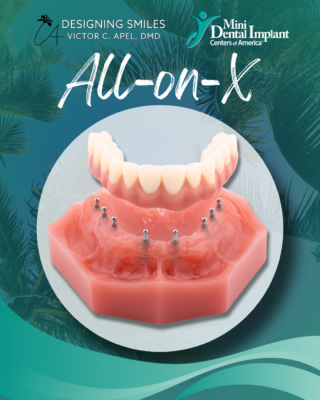
The name sounds like a formula, but the “X” is intentionally flexible. “All” refers to all the teeth in one upper or lower arch. “X” represents the number of implants supporting the roundhouse bridge. That number may differ between patients, and it may even differ between the upper and lower arches in the same patient.
Other full-arch systems use a general set number of implants. All-on-4® uses 4 traditional dental implants, while Fix-on-Six® typically uses approximately 6 to 10 mini dental implants. By using the All on X system, Dr. Apel has greater flexibility to select the number and type of implants based on the support your restoration requires.
Dr. Apel determines the number and placement of your implants by evaluating several key factors. The first is your bone volume and density, the next is the condition of your opposing teeth, your bite forces, and the design of your final restoration. As a result, the number of implants may vary from one patient to another and between the upper and lower arches.
Your All on X Dental Implants Treatment Plan
The number of missing teeth does not tell Dr. Apel how many implants you will need. With All on X, several implants work together to support an entire upper or lower bridge. The right number depends on where those implants can be placed and how much support the finished restoration will require.
How Does Your Jawbone Affect Implant Placement?
Dr. Apel uses a 3D CBCT scan to measure the height, width, and density of your jawbone. The scan gives him a detailed view of the entire arch, showing where the bone can support an implant and where placement may be limited.
You may have less bone in one part of your jaw and stronger, more usable bone in another. Dr. Apel maps those areas across the arch and considers how each implant would contribute to the support of your roundhouse bridge. The amount and location of available bone help him determine how many implants to use and where to place them.
How Much Support Will Your New Teeth Need?
Natural teeth, a removable denture, and another implant-supported bridge respond differently to chewing pressure. Natural teeth have a small amount of natural movement, a removable denture can shift against the gums, and an implant-supported bridge remains firmly anchored. What your new bridge meets will affect how pressure travels through the restoration.
Dr. Apel considers the opposite arch when determining the number and placement of your implants.
Why Does the Size of the Implant Matter?
Dr. Apel uses mini dental implants and other one-piece implants to create support.
Mini implants are less than 3 millimeters in diameter, so they require less bone width than larger traditional implants. Their smaller size may allow Dr. Apel to place them in areas of existing bone that could not accommodate an implant with a wider diameter.
Smaller implants still need sufficient bone to hold securely. In some cases, Dr. Apel may use more implants to distribute support across the bridge. Another patient may need a different number depending on the available bone and the demands placed on the restoration.
Two people replacing the same arch can therefore receive different All on X treatment plans. The number becomes clear after Dr. Apel evaluates the bone and determines how to support the finished bridge.
Considering All on X Dental Implants in Melbourne, FL?
Your All on X recommendation should answer two important questions. How many implants will support the bridge? Why is that number appropriate for your case? Dr. Apel will explain the reasoning behind his recommendation. You can then decide whether the treatment fits what you want from your replacement teeth.
Contact Designing Smiles Dentistry to schedule a complimentary consultation. Find out what a full-arch treatment plan could look like for you!

 English
  Spanish