

Have you ever heard the term floating dentures? For many people, it’s an incredibly frustrating part of daily life. Floating dentures are traditional, removable dentures (often the bottom ones) that don’t provide the secure fit you need. Without the right support, they move while you talk, chew, or sometimes just smile. You can read about it or hear others describe it. But until you’ve lived with it, it’s hard to understand just how troublesome unreliable dentures can be. Adhesives may offer temporary fixes, but we believe you deserve something better. An alternative to stop worrying about what your dentures might do, and finally feel confident in your own smile. At Designing Smiles Dentistry, we provide implant dentures in Melbourne, FL, to restore stability and comfort in everyday life.
Why Won’t My Dentures Stay Put?

If your denture will not stay in place, there is usually a reason for it. Over time, the jawbone and gums can change, which can make even a once-comfortable denture feel loose or unreliable.
Many denture wearers struggle with stability, commonly due to normal changes in the mouth after tooth loss.
When you lose teeth, your jawbone no longer receives stimulation from the tooth roots. Without that pressure from daily chewing, your body begins to absorb the bone that once supported your teeth.
As the jawbone changes shape, your denture may start to shift or float. The appliance may no longer match the shape of your gums, so even slight changes can cause it to rock, slide, or lift during seemingly simple activities. As the hard acrylic rubs against soft gum tissue, the friction can lead to discomfort, blisters, or open sores.
These problems are a natural result of how the body responds to tooth loss. The longer the teeth are missing, the more the jawbone can change, and the harder it becomes for a removable denture to feel secure.
Stabilize Your Denture With Mini Dental Implants
You might be asking yourself: If my tooth roots are already gone, is there really a way to stop the bone loss? Can anything truly keep a denture stable over time? The answer is yes. There is a long-term solution that doesn’t mask the problem; it addresses the cause.
Dental implants are small titanium posts that Dr. Apel places directly into your jawbone. Once placed, your body begins a process called osseointegration. During this process, living bone tissue grows and fuses to the surface of the implant. This bond creates a stable, load-bearing foundation that allows the implant to act like a real tooth root.
Dental implants keep a denture in place and protect the jaw from further bone loss. When you chew with implants, they send pressure into the bone (just like natural teeth do). That pressure stimulates the jaw and signals your body to preserve the bone.
Implant Dentures in Melbourne: Understanding Your Options
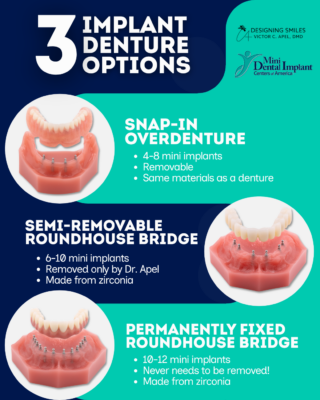
Not every implant denture is the same. The right choice depends on how much stability you want, how much maintenance you prefer, and what your mouth can support.
- Snap-in overdentures snap onto mini dental implants for a more secure fit, but can still be removed at home for cleaning.
- Semi-removable roundhouse bridge stays firmly attached to mini dental implants and is removed only by Dr. Apel during routine maintenance.
- The fixed roundhouse bridge permanently attaches to mini dental implants and never comes out.
Each option offers more support than a traditional removable denture. We’ll walk you through the differences, explain what makes sense for your mouth, and help you choose the level of stability that fits your needs.
Choose Dentures in Melbourne That Feel Secure
A floating denture can make normal moments feel unpredictable. Mini dental implants change how your denture is supported by giving it a secure foundation below the gumline. With the right implant denture, you can move away from temporary fixes and choose an option created for greater stability, comfort, and everyday function.
At Designing Smiles Dentistry in Melbourne, FL, Dr. Apel can evaluate your jawbone, explain your implant denture options, and help you decide which level of support makes the most sense for your needs. If you’re ready to stop planning around a loose denture, schedule a complimentary consultation today.

 English
  Spanish