
Are small-diameter dental implants as strong as traditional implants? Research suggests they can be. A recent review published in BMC Oral Health found comparable survival rates between narrow and conventional implants. The analysis found that a smaller diameter doesn’t necessarily mean a less reliable replacement for missing teeth. Small-diameter dental implants can provide lasting support for replacement teeth, even though they take up less space in the jawbone.
If you’re skeptical that something smaller can be just as strong, nature offers a compelling reason to reconsider. Consider the rhinoceros beetle. Famous for its armor-like body and remarkable strength, this insect can reportedly lift or carry up to 850 times its own body weight. It ranks among the strongest animals relative to its size, demonstrating just how little size alone tells us about strength.
Dental implants and rhinoceros beetles are very different, of course, but both challenge the assumption that something needs to be large to be strong. For small-diameter dental implants, the research offers a more meaningful measure of strength: how well they perform over time.
What Are Small-Diameter Dental Implants?
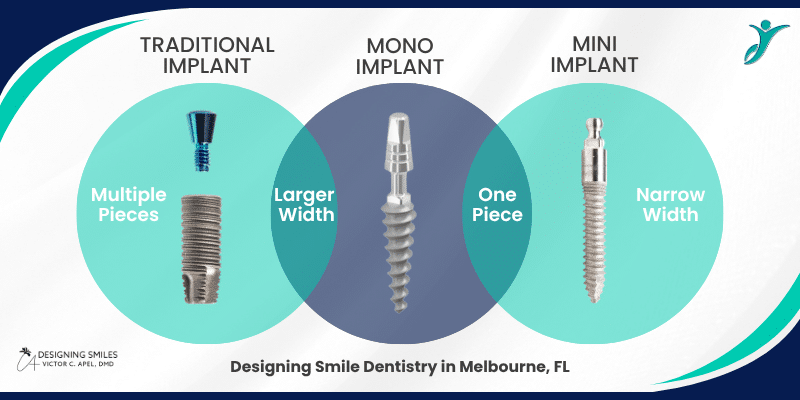
Small-diameter dental implants are narrow titanium posts that replace missing tooth roots and support artificial teeth. Although no universally accepted classification exists for dental implant diameters, smaller implants (sometimes called mini implants) generally measure less than 3.75 millimeters wide, while conventional implants are typically around 4 to 5 millimeters wide.
A difference of just 1 or 2 millimeters may seem insignificant, but space is limited inside the jawbone. Dentists need enough bone surrounding an implant to support it, along with adequate clearance from neighboring tooth roots and other anatomical structures. A smaller implant can be useful when the jawbone is narrow, or the space between adjacent teeth is limited.
Small-diameter dental implants can replace a single tooth, support a bridge, or secure a denture. Dr. Apel considers smaller implants when there isn’t enough room for a conventional implant, especially in areas where the jawbone has narrowed, or neighboring teeth are close together.
How Reliable Are Small-Diameter Dental Implants?
A dental implant must withstand the forces of chewing and biting while staying securely anchored in the jawbone. Wider implants generally have greater resistance to these forces, but mechanical strength is only part of what determines an implant’s long-term performance.
Researchers also evaluate implant survival, which measures whether an implant remains in place and functional over time. The 2023 systematic review published in BMC Oral Health examined 939 dental implants placed in the back of the mouth, where chewing forces are especially strong. Of these, 319 were narrow-diameter implants, and 620 were regular-diameter implants.
The researchers found no statistically significant difference in survival rates between the two groups. They also found no significant difference in the survival of the replacement teeth supported by these implants. These findings suggest that narrower implants can provide reliable support, even in areas exposed to substantial chewing pressure.
However, implant diameter is only one consideration. The amount and quality of surrounding bone, implant position, and forces on the crown, bridge, or denture all influence long-term performance. A smaller implant can be an effective choice when its dimensions and placement suit the restoration it needs to support.
Explore Your Dental Implant Options in Melbourne, FL
A smaller implant shouldn’t be dismissed as a weaker option. Research shows narrow implants can perform comparably to conventional implants, and their reduced diameter can make tooth replacement possible in areas with limited space or bone. The important consideration is choosing an implant that can reliably support your replacement teeth.
At Designing Smiles Dentistry in Melbourne, FL, Dr. Victor Apel evaluates your jawbone, oral health, and tooth replacement needs to determine the right implant option before deciding whether a larger implant may be the best choice, or a smaller diameter may offer advantages you hadn’t considered. You deserve to know what each option can accomplish before making a decision.
Contact our office to schedule a complimentary consultation and learn which dental implant options may work for you.

 English
 Spanish