
Dental bridges vs. implants is a common comparison for patients who need to replace missing teeth. Both options can restore your smile, but the differences are actually more significant than they might initially appear. A traditional dental bridge attaches to neighboring teeth, which must support the replacement tooth. A dental implant anchors into the jawbone, providing support without relying on adjacent teeth. How these treatments work can influence your oral health, the procedures involved, and the long-term maintenance of your replacement teeth.
At Designing Smiles Dentistry in Melbourne, FL, Dr. Victor Apel believes that replacing a missing tooth should never come at the unnecessary expense of your remaining healthy teeth. Traditional bridges have their place, but dental implants provide another possibility: replacing the missing tooth without altering its neighbors. And with mini dental implants, even patients who have experienced some jawbone loss may have options they hadn’t previously explored. Before choosing between a bridge and an implant, it’s worth understanding what each treatment requires of the teeth and bone you still have.
Dental Bridges vs. Implants: Key Differences To Know
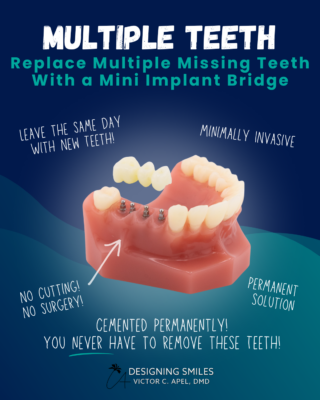
Dental bridges are a popular solution for replacing missing teeth, and their design is clever—they span gaps in your smile by anchoring to the teeth on either side. While this method can restore the appearance and function of your teeth, limitations can become evident over time.
Think back to building a blanket fort as a child. Everything seemed solid at the start, with books and furniture on either side holding up your masterpiece. But as you shifted around, the strain on those supports increased. Eventually, the fort sagged or collapsed, no matter how carefully you tried to fix it. A traditional dental bridge works much the same way. The neighboring teeth—once strong and healthy—bear the burden of supporting the bridge. Over time, this extra stress can weaken those teeth, leaving them vulnerable to damage or decay.
The limitations go further. A dental bridge only addresses the visible gap in your smile but doesn’t replace the missing tooth root. As a result, the jawbone beneath the gap isn’t being stimulated, which can lead to bone loss over time. As the bone shrinks, your jaw structure changes, which compromises the fit and longevity of the bridge. In contrast, implant solutions provide a more sustainable alternative.
Dental Bridges vs. Implants: How Do They Compare?
Implantes dentales redefinen la forma de abordar el reemplazo de dientes, ofreciendo una solución que se siente natural y apoya su salud oral a largo plazo. El Dr. Apel coloca estos implantes directamente en el hueso maxilar, creando una base tan sólida y fiable como sus dientes originales.
Fabricados en titanio, un material apreciado por su resistencia y compatibilidad con el cuerpo humano, los implantes hacen algo más que sustituir los dientes perdidos. Se fusionan de forma natural con el hueso maxilar mediante un proceso denominado osteointegración. Esta fusión significa que el implante pasa a formar parte de la estructura ósea, proporcionando un soporte inquebrantable para una dentadura normal. corona o puente al tiempo que favorece la salud del hueso circundante.
Los implantes dentales son independientes, a diferencia de los puentes tradicionales, cuya estabilidad depende de los dientes adyacentes. Funcionan como un poste robusto que ancla firmemente la restauración sin ejercer presión sobre los dientes adyacentes. Esta independencia ayuda a preservar la integridad de los dientes restantes al tiempo que ofrece la fiabilidad y longevidad que necesita.
Are Mini Dental Implants Less Invasive?
Dental procedures can make even the bravest among us nervous. In fact, nearly 36% of Americans report miedo al tratamiento dental, with 12% experiencing an extreme level of anxiety. Add oral surgery to the mix, and it’s no wonder many people hesitate to consider dental implants. But what if there were a less invasive, more approachable solution?
Miniimplantes dentales measure less than 3 millimeters in diameter, making them considerably narrower than conventional implants. Their smaller size can make a meaningful difference in how Dr. Apel places them. In many cases, he can insert a mini implant through a small pilot opening in the gum tissue and jawbone, without making a large incision or lifting the gums away from the bone. This minimally invasive technique typically involves less tissue disruption, minimal bleeding, and a shorter recovery period.
Implant diameter also affects how much jawbone is needed for placement. Patients who have lost bone after losing a tooth may not have enough width to accommodate a conventional implant without bone grafting. A mini dental implant requires less space, so Dr. Apel may be able to use the existing bone without additional grafting.
Compare Your Tooth Replacement Options in Melbourne, FL
A missing tooth leaves you with a decision, but you shouldn’t have to make it based on guesswork. At Designing Smiles Dentistry, Dr. Victor Apel will examine your remaining teeth, evaluate your jawbone, and explain which replacement options best fit your oral health. We’ll discuss traditional dental bridges, dental implants, and minimally invasive mini implants, including what each treatment would involve for you.
Reserva tu consulta gratuita at our Melbourne, FL, office to discuss your options with Dr. Apel.

 Spanish
 English